





Fig. 1. European spruce bark beetle infestation. Bore hole in the trunk, with exuded resin. Photo: Valentin Queloz (WSL)
Satellite imagery, drones and aircraft-mounted cameras have so far been unable to reliably detect infested spruce trees early enough for effective sanitation management. This is because of the interplay between the biology of the bark beetle, the trees’ response, and the technical possibilities: the time between infestation and the emergence of the beetles is shorter than the time needed for the changes in the tree canopy to become detectable using current remote-sensing methods. Terrestrial control surveys thus continue to be indispensable, although remote sensing can offer useful supplementary options in certain situations.
Why the time frame is so short
The European spruce bark beetle (Ips typographus) primarily infests already weakened spruce trees (Picea abies) and, if it proliferates on a massive scale, can cause vast areas of forest to die off within a short period of time. The principle behind tackling it is simple: infested trees must be identified and removed before the new generation of beetles emerges and spreads to neighbouring trees. If the sanitation measures are completed before the beetles emerge, they will be effective; afterwards, they will be of little use.
In colline to submontane regions of central Europe, the young beetles typically emerge 6 to 10 weeks after the initial infestation. During this time, the spruce shows little outward sign of change: the crown remains green for the time being, while the beetle begins to develop underneath the bark. It is only when the phloem and fine roots die off and the water supply to the crown breaks down that changes in the crown spectrum become apparent: the chlorophyll and water contents decrease, with an associated increase in temperature in the canopy. It is these signals that optical remote-sensing systems detect – and therein lies their fundamental limitation. The changes they can measure only become apparent once the damage is already well advanced. As a result, detection usually occurs too late for effective sanitation (fig. 2).
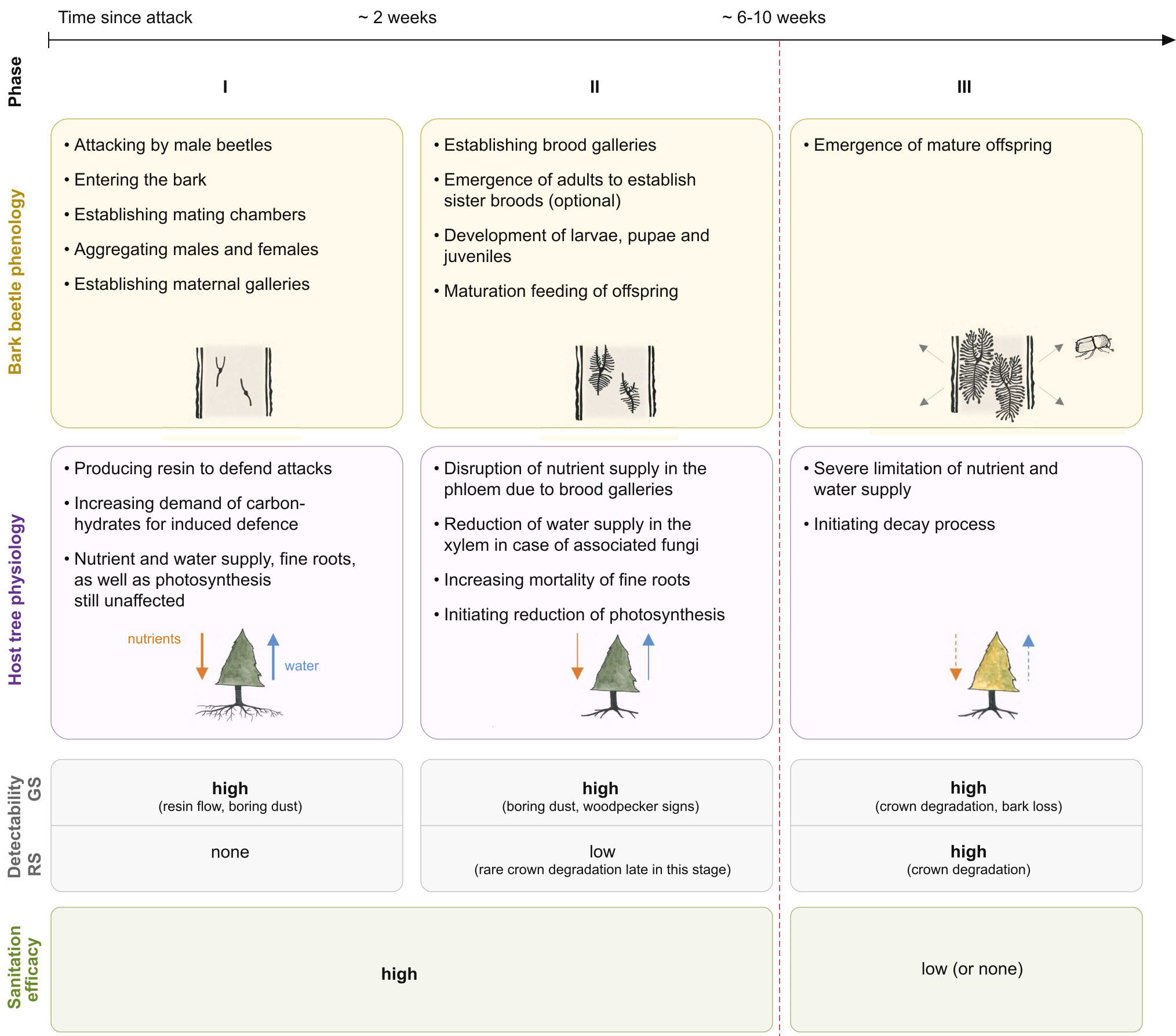
Fig. 2. A schematic overview of the phenology of Ips typographus, the physiology of Picea abies, the detectability of infestation via terrestrial surveys (GS) and remote sensing (RS), and the effectiveness of sanitation measures over time. The vertical red dotted line marks the crucial point in time for effective bark beetle management. Source: Kautz et al. (2024), modified.
From a management perspective, an infestation is only considered to have been detected in time if it is detected before the young beetles emerge. Many remote-sensing studies use terms such as ‘early detection’, ‘green-attack stage’, or ‘early-attack stage’ loosely. This has led to unrealistic expectations of the potential of remotely-sensed detection. Only early detection in the sense of pre-emergence detection allows for effective sanitation of the infested tree.
No approach achieves the necessary accuracy
A critical review of recent research (Kautz et al. 2024) evaluated 26 scientific papers published between 2000 and 2022 that explicitly addressed the early detection of European spruce bark beetle infestation using remote sensing. The study examined approaches using satellites (54% of the studies), aircrafts (23%), drones (19%) and, in one case, terrestrial sensors. Passive multispectral systems were the predominant sensor type; active sensors such as Lidar and Radar were used in only four studies.
The studies assessed the detection accuracy of remote sensing methods on the basis of two simple questions: To what extent do the infestations detected by each method actually represent infestations (detection rate)? And how many of the infested trees are missed (error rate)?

Fig. 3. Dead (grey), dying (reddish-brown) and presumably also freshly infested spruce trees (not yet discoloured) on a spruce bark beetle infestation site. Photo: Valentin Queloz (WSL)
The results are consistently unsatisfactory. In the 17 studies with reliable data, an average of only around 59% of the trees classified as infested were actually infested, and only around 63% of the infested trees were detected. None of the studies met the threshold of 80% - set as the minimum requirement for practical application - on both criteria simultaneously.
By way of comparison, when frequent and systematic terrestrial surveys are carried out in the stand, around 91% of the trees classified as infested are indeed infested, and around 93% of the trees that are actually infested are detected.
The findings on timeliness are even more significant: in only 5 of the 26 studies was it at all likely that the infestation was detected before they emerged. In most cases, infested trees were thus only identified at a stage when effective sanitation was no longer possible, which consequently limits the practical usefulness of the remotely-sensed detection.
Why remote sensing reaches its limits
As well as the delayed response of the spruce crowns, cloud cover is another fundamental problem that is often underestimated. Passive sensors – which make up the vast majority of the systems in use – require cloud-free conditions. In the spruce-dominated regions of central and northern Europe, average cloud cover during the European spruce bark beetle’s main activity period (April to October) is 50 to 80%. In the low mountain ranges of central Europe, this means that there are on average only 7 to 12 cloudless days per month.
Under ideal weather conditions, Sentinel-2 satellites can provide an image every five days; with 60 to 70% cloud cover, this interval increases to an average of 15 days. That is too long to allow for timely intervention, given the short time window between appearance of the first signs of crown degradation and beetle emergence. Active sensors such as Radar or Lidar are not affected by cloud cover and are therefore generally more suitable; however, they have hardly been studied to date.
Furthermore, remote sensing merely measures losses in tree vitality. It does not detect bark beetle infestation itself. Drought stress, nutrient deficiency or damage to the crown caused by storms or snow produce spectral signals similar to those of a fresh bark beetle infestation. Unequivocal classification is thus difficult and, particularly in dry years, there may be misclassifications, which can tie up monitoring resources and undermine confidence in the method.

Fig. 4. Hibernation trees in autumn. Dying spruce trees (reddish-brown) in a green stand. Photo: Valentin Queloz (WSL)
Where remote sensing is useful today
Despite these limitations, there are specific situations in which remote sensing offers genuine added value for bark beetle management.
One particularly promising application is with hibernation trees: beetle broods that have been established under the bark in late summer develop during the autumn. In central Europe, they usually hibernate within the tree, only emerging again to attack other trees the following spring. The traces of bore dust that are so important for terrestrial surveys thus do not appear, but at the same time, the crown begins to show signs of discolouration. From September/October, this opens up a window of opportunity for remote sensing: these trees can be identified during the autumn and winter months and removed before the beetles emerge in spring.
Remote sensing can also be used to pinpoint infestation hotspots, thereby enabling targeted terrestrial control surveys. As subsequent infestations typically occur within a radius of 100 to 300 metres, monitoring measures can be concentrated in a specific area, even if detection occurs too late for immediate remediation. In addition, remote sensing is particularly useful as a back-up for terrestrial surveys in relatively inaccessible or extensively managed stands, where the possibilities for terrestrial surveys are limited.
Last but not least, remote sensing offers a rapid means of providing data on extensive areas of spruce trees damaged by wind, which are ideal potential breeding sites for the European spruce bark beetle and therefore need to be cleared promptly.

Fig. 5. Drone in operation over a spruce forest. Photo: Petra D'Odorico (WSL)
Requirements for better systems
The following technical requirements are essential for an operational system enabling early detection: sensors capable of detecting changes in the upper crown region; a spatial resolution that allows individual crowns to be identified; and an imaging frequency of 1 to 3 days. Active sensors such as Radar or Lidar components could at least partially mitigate the cloud-related issues presented by passive sensors. However, their suitability for the early detection of bark beetle damage has not been conclusively demonstrated to date. In addition to this, advanced AI algorithms based on machine learning and deep learning are increasingly providing methods for more in-depth analysis of remote-sensing data.
The biological constraints remain, however: changes in the crown that reliably indicate a European spruce bark beetle infestation only become apparent once the damage to the phloem has progressed – by which point it is too late to effectively treat the infested tree. Technological advances may alleviate this fundamental problem, but they are unlikely to solve it entirely.
For forestry practice

Fig. 6. Early signs of infestation on the trunk (bore dust, resin droplets) can only be detected through terrestrial surveys. The same is true for discolouration at the base of the crown. Photo: Felicitas Sander (FVA BW)
This has clear implications for bark beetle management in practice: reliable early detection of infestation with the European spruce bark beetle is not currently possible using remote sensing alone. Regular, frequent terrestrial surveys remain the only reliable method for identifying infested trees in good time. Remote sensing can complement these terrestrial surveys in specific situations, but cannot replace them:
- In practice, remote sensing is most relevant in autumn for detecting hibernation trees, when there are no traces of bore dust and the crowns begin to discolour.
- Infestation hotspots that have been identified – even if it is too late for immediate sanitation – help with the prioritisation of terrestrial surveys in the following season.
- Remote sensing is particularly useful as a complementary measure in terrain that is difficult to access or in stands where there is insufficient capacity for terrestrial surveys.
- Accuracy figures published in remote sensing studies should be viewed critically: many refer to late stages of infestation or small random samples for validation, and are not transferable to operational conditions.
Literature
Kautz M., Feurer J., Adler P. (2024) Early detection of bark beetle (Ips typographus) infestations by remote sensing – A critical review of recent research. Forest Ecology and Management 556: 121595. doi.org/10.1016/j.foreco.2023.121595