





Fig. 1. European - spruce bark beetle infestation in a spruce stand. Higher temperatures and drought stress promote the development of bark and wood borers and increase the biotic risk. Photo: Swiss Forest Protection Switzerland (WSL)
The extent to which forest pests benefit from climate change depends not only on the site, but also on their ecological strategy. Wood and bark borers react differently to changing climatic conditions than defoliators or pathogens. An evaluation of almost 200 international studies systematically links climate reactions and damage potential for the first time, permitting a comparison of the biotic risks of key tree genera.
Effects of temperature and drought on forest pests
It is well documented that higher temperatures promote the development of many forest pests (Warlo and Kautz 2024). Insects develop faster, produce more generations per year, and survive mild winters better. Many fungal pathogens also grow faster with rising temperatures, or are able to expand their range.
Drought has an effect through other mechanisms. Water stress alters the physiology of trees, for example through shifts in the water balance and in the concentration of secondary metabolites. This leads to changes in the trees’ immune responses and nutrient quality - having stimulating or inhibiting effects depending on the intensity and ecological strategy of the harmful organisms.
The functional group is decisive. Wood and bark borers benefit particularly from weakened host trees. Defoliators react more strongly to changes in leaf chemistry, which may promote or impair their development. Pathogens also have different reaction patterns.
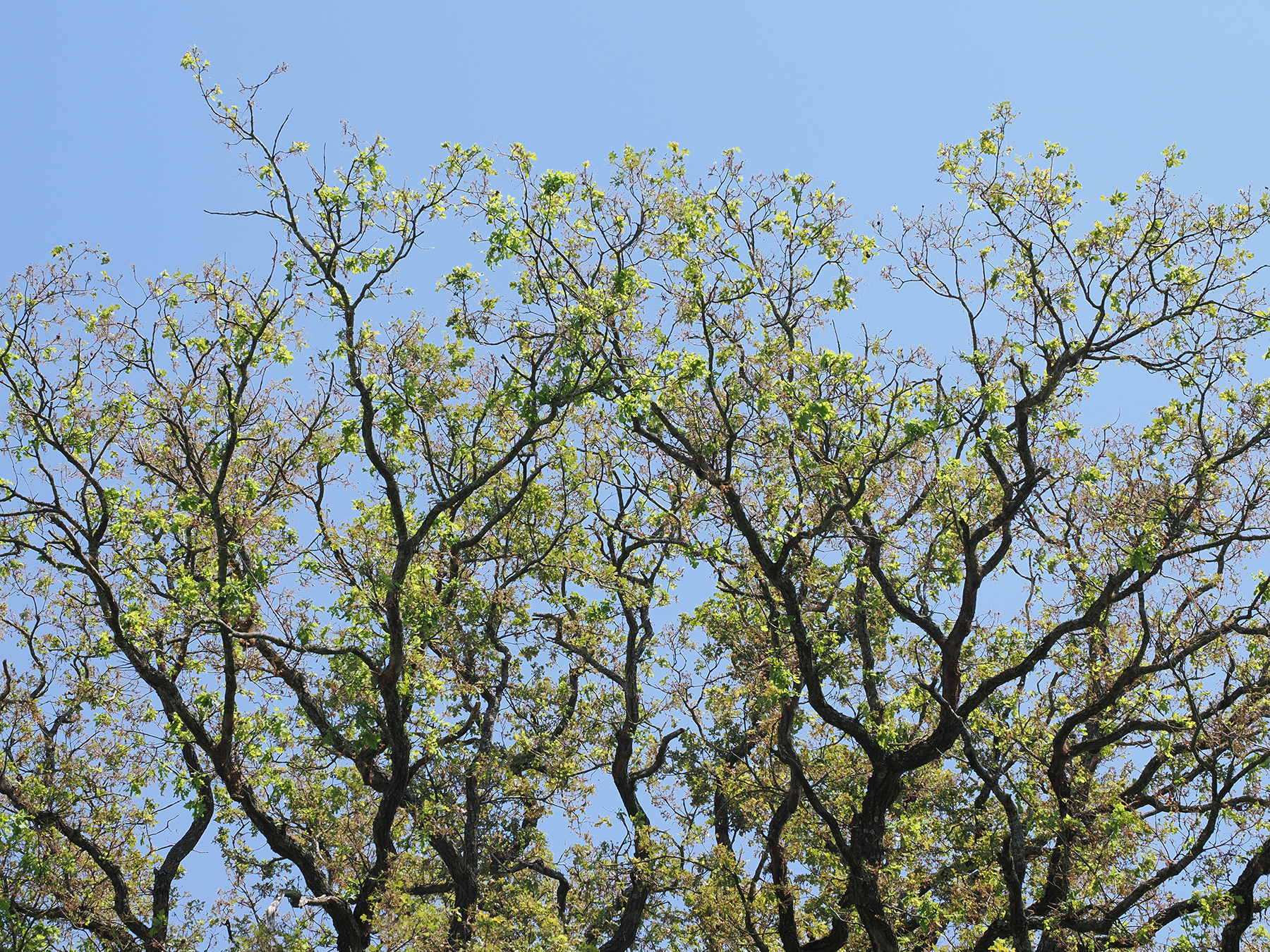
Fig. 2. Severe leaf damage caused by caterpillars in a deciduous stand. Drought stress and changes in leaf chemistry can promote - or also restrict - the development of defoliators. Photo: Valentin Queloz (WSL)
From individual studies it is not possible to deduce which mechanisms carry greater weight in the comparison. Instead, a systematic comparison of climate responses and damage potential is required.
Biotic risk according to tree genus
In order to systematically compare the effect of these factors, the Forest Research Institute of Baden-Württemberg (FVA BW) has carried out a comprehensive meta-analysis (Warlo et al. 2025). The researchers evaluated almost 200 publications with a total of 457 observations on 55 insect and pathogen species that occur on six economically important tree genera in Europe: spruce (Picea), fir (Abies), oak (Quercus), pine (Pinus), Douglas fir (Pseudotsuga) and beech (Fagus). For each species, they recorded how higher temperatures and drought affect development, survival, reproduction and dispersal. In addition, forest protection experts from Germany, Austria and Switzerland assessed the specific damage potential of the species - including their spatial spread, the type of damage caused, and their ability to infest even healthy trees.
From the combination of climate response and damage potential, the researchers were able to calculate a weighted total value for temperature and drought effects for each tree species. The resulting risk index permits a comparison of the future biotic threat potential (Fig. 3).
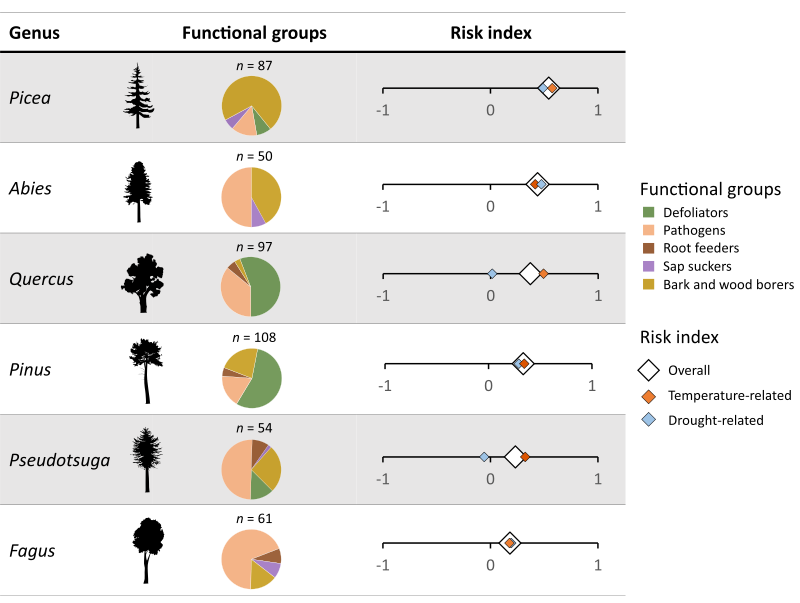
Fig. 3: Proportions of the functional pest groups (n = number of observations) and the overall risk index for the tree genera, together with the respective indices for temperature- and drought-specific risk alone. A positive risk index indicates an increase in the biotic risk for the respective host tree genus under warmer and drier conditions. The pie charts show which functional groups make up the observations for each genus. Source: Warlo et al. 2025.
Ranking in biotic risk potential
The comparison shows clear differences between the tree genera:
- Spruce (Picea) and fir (Abies) have the highest biotic risk.
- Oak (Quercus) and pine (Pinus) are mid-range.
- Douglas fir (Pseudotsuga) and especially beech (Fagus) currently show the lowest increases in risk.
This ranking does not imply absolute certainty or a threat to individual tree species. Instead, it shows where biotic risks are increasing particularly strongly under climate change conditions.
Why spruce and fir are particularly affected
In spruce and fir, bark- and wood borers dominate, especially the European spruce bark beetle. Higher temperatures allow the beetle to produce additional generations per year, while drought stress reduces the trees' defences. This combination has a particularly detrimental effect.
In addition, many of these pests have a high damage potential: they can affect not only individual trees, but entire stands or landscapes, and they often lead to the death of their host trees. This explains why spruce is the most endangered species compared to other tree genera – despite many years of “experience” in dealing with bark beetles.
Oak and pine: differentiated effects
With oaks and pines, defoliators and pathogens play a greater role. Rising temperatures usually increase the risk here, whereas drought has a much less uniform effect.
In oaks, for example, warmer conditions often increase the risk posed by insects, whereas drought has barely any additional effects. In pines, both defoliators and bark beetles contribute to the risk, but in lower concentration than in spruce.
In practice, this means that damage is more likely to occur, but is often less explosive than classic bark beetle calamities affecting spruce.
Douglas fir and beech: lower risk - for now
Douglas fir and beech show the lowest risk indices in the comparison. In the case of Douglas fir, it is striking in some of the studies analysed that drought even led to lower pest activity. Pathogens whose response to climatic factors is less clear dominate in the case of beech.
It is important to note that this analysis only considers pests that are currently established in Europe. New invasive species or changes in interactions may change the picture in the future. In the case of Douglas fir in particular, it remains to be seen how the risk will develop with increasing geographical spread
Temperature is a more potent driver of biotic risk than drought
In the majority of cases, higher temperatures led to a greater increase in biotic risk than drought.
In the studies analysed, rising temperatures are generally associated with improved development and in some cases with increased reproductive performance of the species under consideration.
The effects of drought are much less uniform. In tree species with a high proportion of wood- and bark borers - especially spruce and fir - drought stress further increases the risk. In genera with many defoliators or specific pathogens, on the other hand, drought has little or no influence.
Temperature thus acts as a comparatively consistent driver of risk, whereas drought changes the risk differently depending on the pest group. The decisive factors are the interaction between temperature and drought, and the functional composition of the harmful organisms within a tree genus.
Consequences for silviculture and forest protection
The results make it clear that biotic risks should systematically be included in tree species selection and in site assessments. In many previous assessments of climate tolerance, the emphasis has been on growth, drought stress or wind storms. Risks posed by insects and pathogens, on the other hand, are often only touched on briefly. The risk index presented here makes it possible for the first time to compare the biotic risk potentials of tree species and to include them in considerations of species suitability.
Tree species selection and mixing strategies
For tree species that are highly susceptible to biotic threats, such as spruce and fir, a mixture of different species in the stand is becoming increasingly important. Mixed stands can reduce vulnerability to individual harmful organisms by slowing their spread and breaking up contiguous areas of host trees. The systematic combination of tree species with different risk profiles contributes to the stability of the stands.
There is limited room for manoeuvre all the same. In many regions, the number of climatically suitable tree species is small. If biotic risks are also taken into account, the requirements for assessment are even more exacting and this reduces the choices for particular sites still further.

Fig. 4. Structurally rich mixed stand. Combining tree species with different risk profiles can limit the spread of specialist harmful organisms. Photo: LFI/WSL
Further development of the risk index
The risk index only takes into account harmful organisms that are currently established in Europe. Newly introduced species or altered interactions can significantly shift the risk profile. Consistent monitoring thus remains the key if we are to recognise risks at an early stage and be able to react in good time. The risk index can be continuously adapted and updated as new data becomes available.
The bottom line
Climate change is increasing the biotic risk for important tree genera in Europe - but to varying degrees. Spruce and fir are particularly affected, while beech and Douglas fir are currently much less so. Temperature is the key driver, with the effects of drought varying depending on the pest group.
The risk index permits these threats to be classified comparatively for the first time, and supplements existing assessments of tree species suitability, which are often based on abiotic factors. It is not a forecasting tool, but a tool for categorisation based on current knowledge.
Translation: Tessa Feller
Literature
Warlo H., Delb H., Albrecht A., Kautz M. (2025) Biotic risks to important tree genera under climate change in Europe. Journal of Cultivated Plants / Journal Für Kulturpflanzen, 77(2), 25–35. doi.org/10.5073/JfK.2025.02.03.
Warlo H., Kautz, M. (2024) How do global forest pests respond to increasing temperatures? – a meta-analysis. Oikos, 2024: e10842. doi.org/10.1111/oik.10842.
Detailed methodological information and literature references can be found in the original scientific publication (PDF).

