




Fig. 1. Diverse stands with forest gaps can promote conditions for foraging bats. Old and dead trees are however needed to secure roosting sites. Photo: Nora Dalüge
Forest management not only shapes the tree species composition and structure of forests, but also influences the ecological interactions within them. Selective tree removal and the resulting gaps and open forest structures can increase bat activity by facilitating foraging flights, particularly for fast-flying species that require unobstructed airspace.
A new study from the Black Forest has now demonstrated that canopy openness also affects insect abundance and thus indirectly influences bat activity through food availability.
At the same time, tree removal reduces the availability of trees with microhabitats such as cavities, crevices, or bark pockets, which develop as trees age and offer important roosting opportunities for bats.
This creates a dilemma: While open canopies can promote foraging habitats, intervention measures also reduce the availability of bat roosts.
To promote bats, which can contribute significantly to insect pest reduction in forests (Beilke and O'Keefe 2023; Charbonnier et al. 2014), it is therefore necessary to implement a range of measures to increase open forest structures, but also promote deadwood and old-growth elements.
Contrasting effects of forest management on bat guilds
Bats can be grouped into three ecological guilds, based on differences in their morphology and echolocation, which determine their flight behaviour: short-range echolocators (SRE), mid-range echolocators (MRE) and long-range echolocators (LRE); tab. 1. This categorisation helps to explain different reactions of bats to changes in forest structure, and what is perceived as a “good” forest: In dense stands, only very agile SRE-bats can navigate around the trees; in forest edge habitats with open canopies and corridors the activity of MRE-bats increases; and LRE-bats fly above the canopy or require large, contiguous open areas or wider forest roads.
| Guild | Genera | Flight space and hunting method |
|---|---|---|
| Short-range echolocators (SRE) | Myotis (mouse-eared bats), Plecotus (long-eared bats), Barbastella (barbastelle bats) | Agile flight close to vegetation, foraging even in denser forests |
| Mid-range echolocators (MRE) | Pipistrellus (pipistrelle bats), Hypsugo (Hypsugo savii, Savi’s pipistrelle) | Flight in semi-open forest habitats, such as along forest paths and forest edges |
| Long-range echolocators (LRE) | Nyctalus (noctule bats), Eptesicus (serotine bats), Vespertilio (vesper bats) | Fast flight in open airspace, e.g. over the canopy, along forest roads, and in larger forest gaps |
In temperate European forests, where close-to-nature forest management prevails, continuous forest canopies are promoted, trees are relatively densely packed, and there are few gaps. Such conditions can be too dense for many bat species, so their activity is often concentrated along forest edges and roads, or increases after thinning operations or tree harvests. After management cessation, it can therefore take several decades for forests to regain sufficiently open structures for bat activity to increase (Carr et al., 2020).
Guild-specific responses of bat activity to canopy structure have been shown in numerous studies. Yet how they are linked to foraging and roosting resources remains poorly understood. A recent study from the Black Forest therefore used structural equation models to test direct and indirect relationships between forest management intensity, forest structure, insects, and bats, revealing that management affects bats through both habitat structure and changes in insect communities (fig. 2).
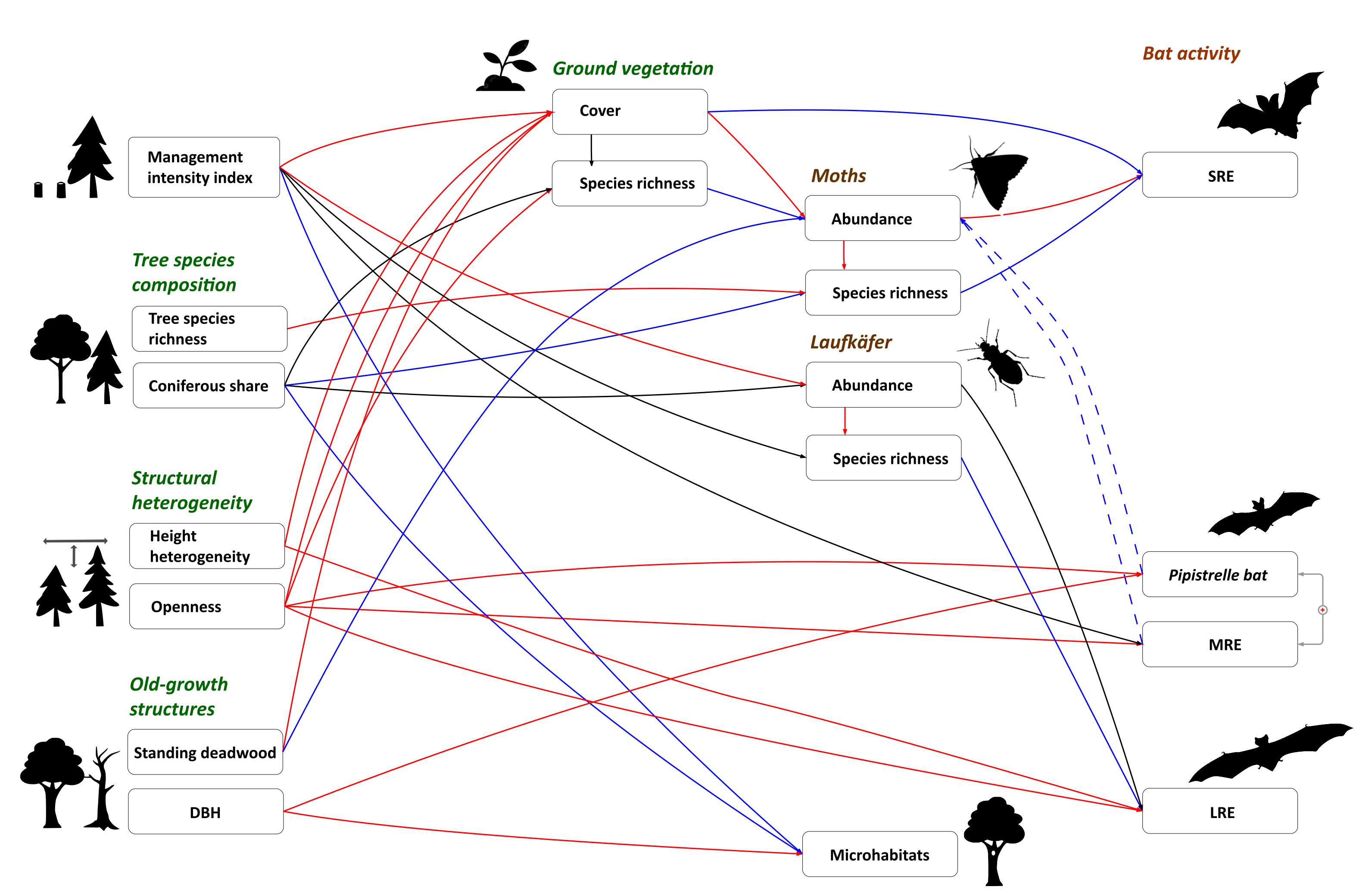
Fig. 2. Visualisation of the relationships found in the study between forest structures, management intensity, ground vegetation, insects, and bats. Red arrows indicate positive influences, blue arrows negative influences, and black arrows symbolise correlations with an optimum (unimodal relationship). While solid arrows show effects at higher trophic levels (bottom-up), dashed arrows highlight reverse effects (top-down). Source: Hendel et al. 2025 (modified).
New insights into relationships between bats and insects
Forest management interventions promote understorey vegetation, which increases moth abundance and thus the food supply for bats. SRE bat species, actually adapted to closed forests (cf. tab. 1), therefore benefit indirectly from management through higher moth abundance. While moth abundance has previously been found to increase with forest vegetation density or with time since management cessation (Carr et al., 2020), the new study identifies understorey vegetation as a key driver of moth abundance in continuous-cover forests.
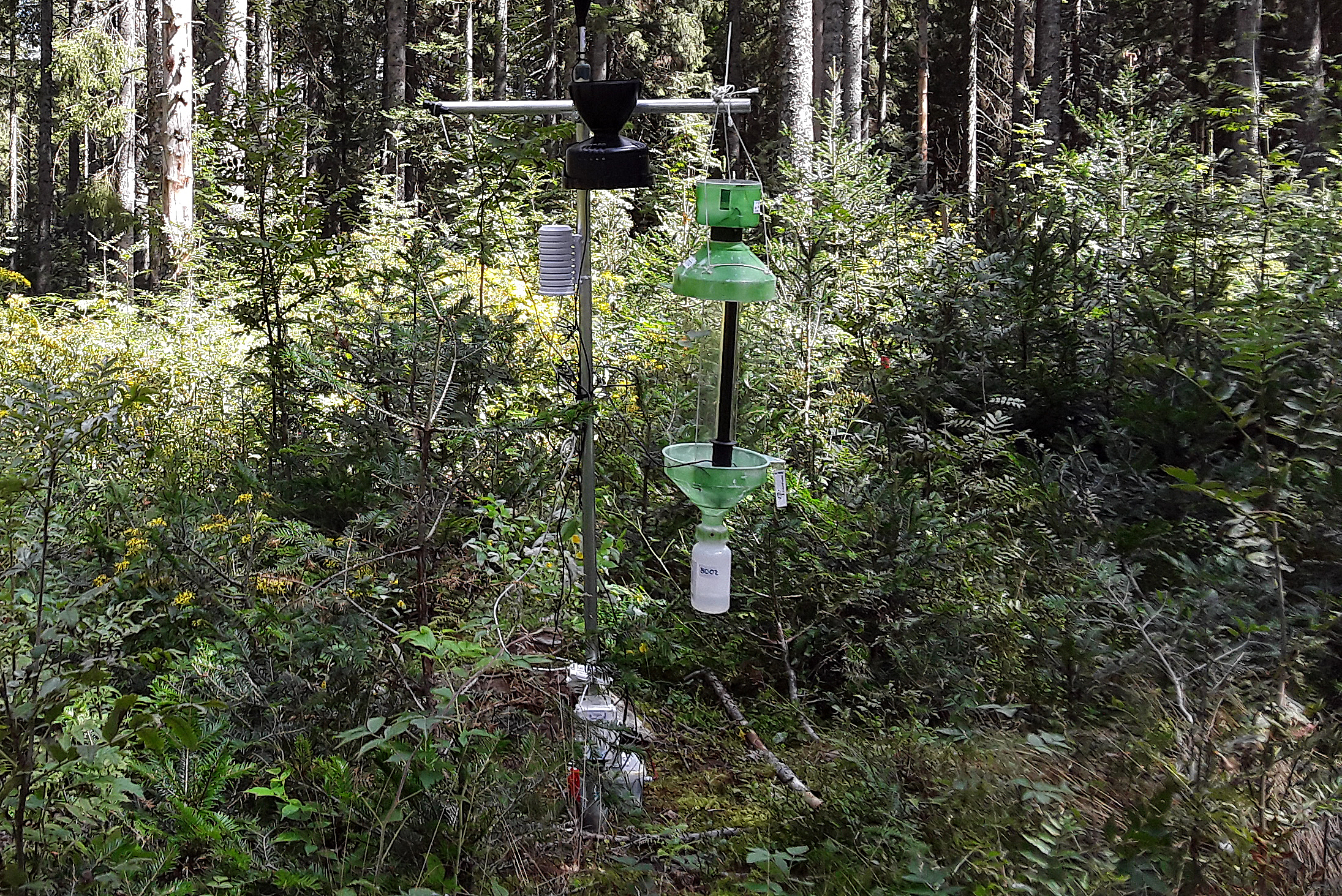
Fig. 3. Dense ground vegetation in open forests increased moth captures. The photo shows the parallel recording of moths with UV-light traps and bats with automatic acoustic recording devices. Weather data was also recorded. Photo: Anna-Lena Hendel
While SRE activity can decline with increasing tree density in forests, it can also be lower in forest gaps (Froidevaux et al. 2016). The effect of forest gaps on SRE bats, including many specialised Myotis species, likely depends on the size of the gaps: small gaps still provide sufficient cover for the animals (Jung et al. 2025). In the Black Forest, not openness but ground vegetation cover had a negative effect on SRE activities. Although understorey vegetation increased moth abundance, some SRE species need free access to the forest floor to forage. This is particularly important for the greater mouse-eared bat (Myotis myotis), which collects ground beetles from leaf litter and finds suitable foraging habitats in mature beech forests.
In addition, the intensity of forestry intervention increased the abundance of ground beetles, which constitute important prey resources for specialised bat species and may have benefited from the enhanced structural complexity of their ground-level habitats.
The Black Forest study provides an important basis for further research, showing that insect availability is strongly influenced by management intensity, forest structure, and tree species composition — often indirectly via the understorey vegetation. For the first time, it documents the reactions of SRE bats to insect abundance, although not to insect diversity. In addition, the study shows top-down effects demonstrating that bats not only respond to forest structure, but also shape forest food webs (Fig. 1 dashed lines): on nights with high activity levels of MRE and pipistrelle bats (Pipistrellus pipistrellus), moth abundance decreased significantly. Either the bats preyed on the moths, or the moths may have evaded them, as many moth species can hear ultrasonic calls and respond with evasive manoeuvres or by remaining motionless. This may lead to dynamic shifts in insect hotspots and could disadvantage less competitive SRE species.
Microhabitats: roosts as a limiting factor
Foraging habitats are only one important component of bat habitats. For many bat species, tree cavities, crevices, and bark pockets are crucial (fig. 4). Even smaller cavities, such as those created by woodpeckers or through broken-off branches, can be suitable bat roosts. Within the tree roosts, bats find hiding places, places to raise their young, or to hibernate during winter. In the Black Forest, the availability of such roosting structures decreases with increasing forest management intensity and with increasing proportions of conifers. Trunk diameter has a positive effect: where there are large trees, the availability of suitable roosts increases. Likewise, dead trees and pioneer tree species, which have a greater variety of microhabitats even at smaller diameters (Spînu et al. 2022; 2023), can also increase roost availability. In the study, there was no correlation between microhabitat density and bat activity. This does not mean that the microhabitats are any less critical. As bats change their tree roosts frequently, they need a large selection of tree roosts. Old trees, groups of habitat trees, and standing deadwood all provide microhabitats. The absence of these considerably limits the forest's ecological functionality for bats.
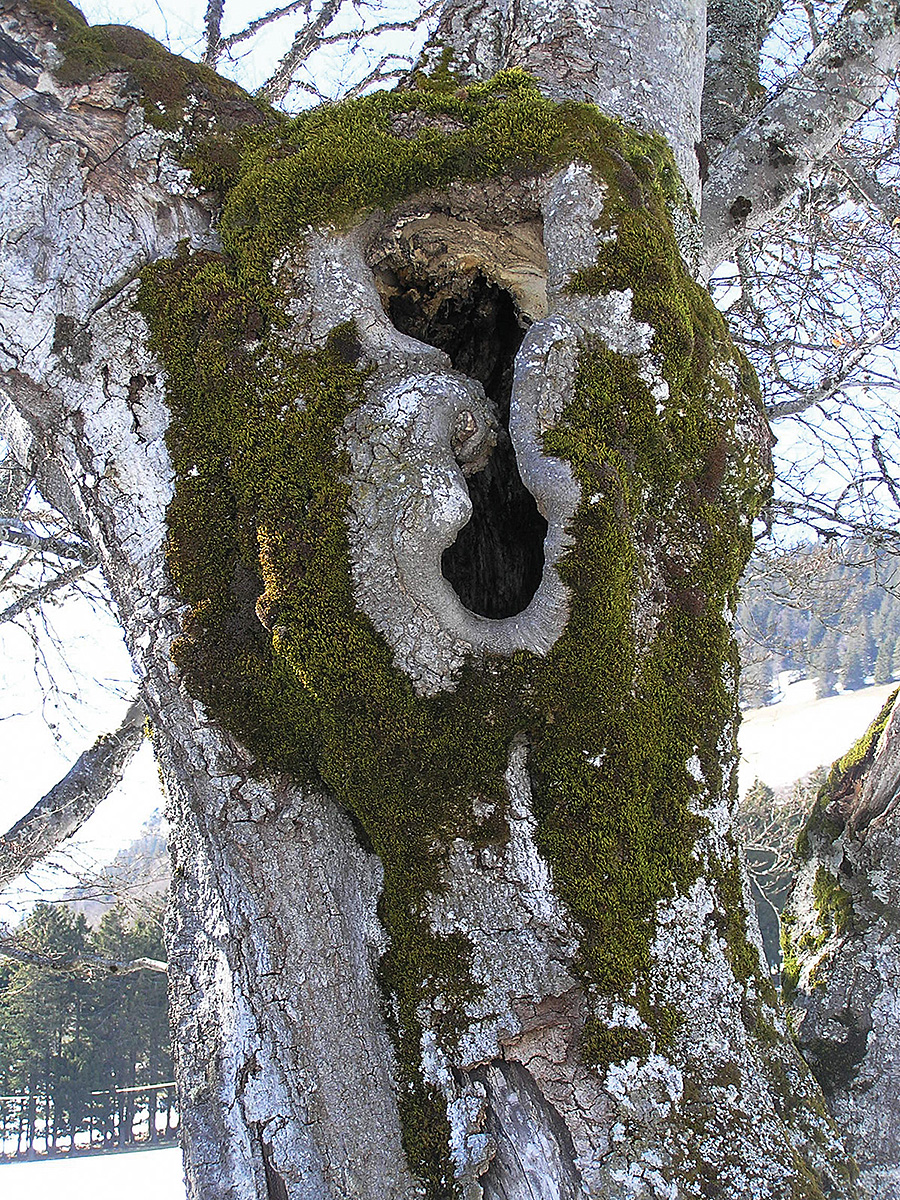
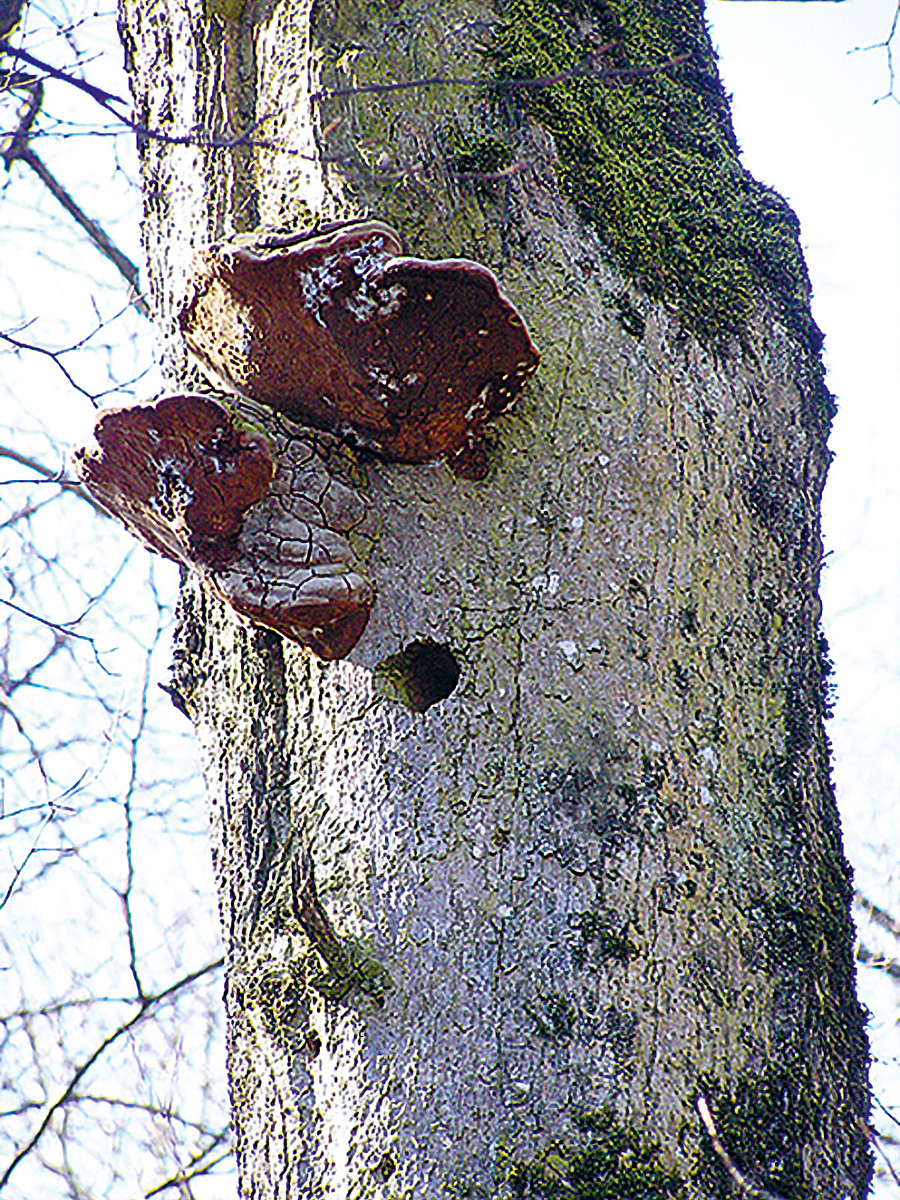
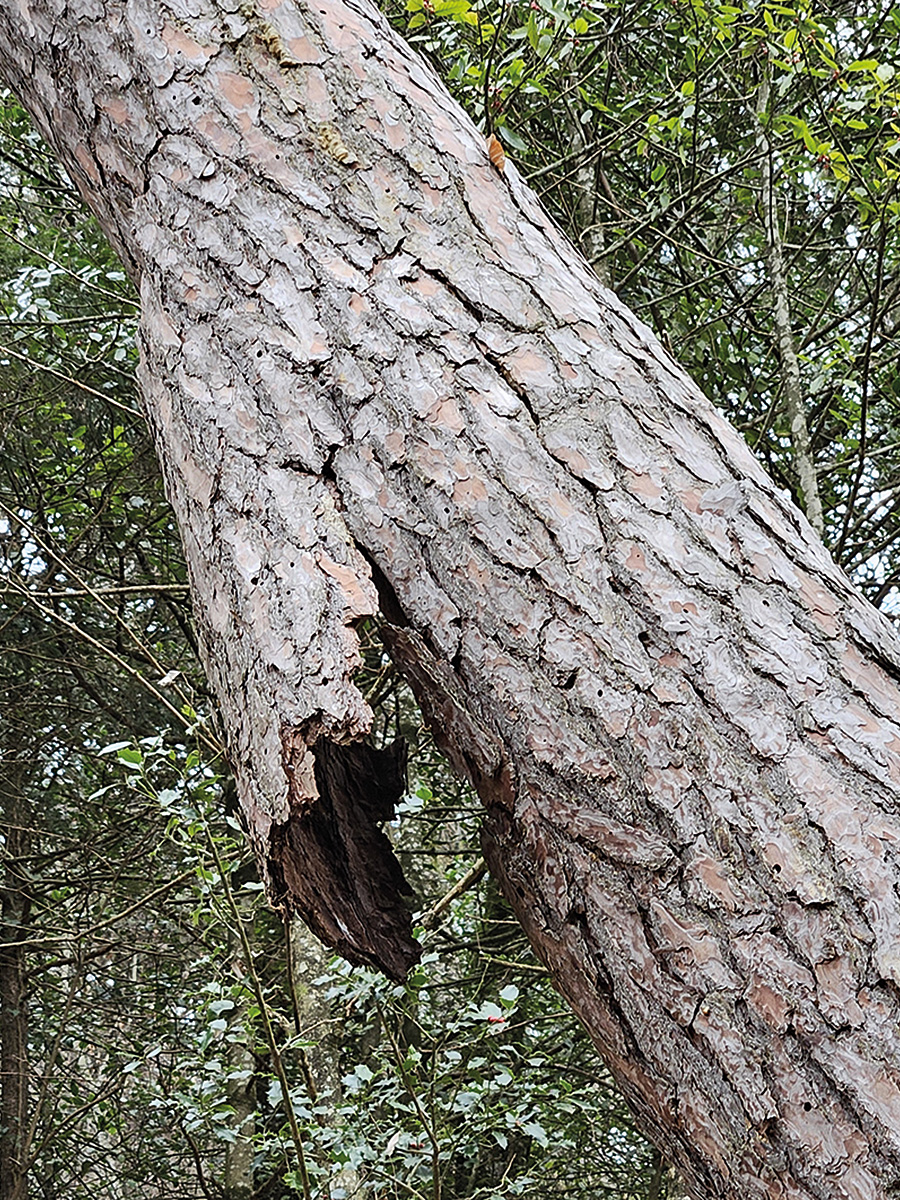
Fig. 4. With increasing forest management intensity, microhabitats such as rot cavities, woodpecker holes, crevices, and protruding bark pockets become increasingly rare – and with them, safe roosting sites for bats. Photos: Field Guide to Tree-Related Microhabitats
Why bat conservation is important
All bat species native to central Europe rely on forests and are highly sensitive to environmental change. Bats are highly efficient insect predators that help control insect pest populations and, in doing so, contribute valuable support to forestry. Because bats have low reproductive rates, the loss of individual roosts can significantly affect local populations. Protective measures in forests are therefore vital for their conservation and are legally binding under national and European law. All species occurring in Europe are listed in Annex IV of the Habitats Directive, and some are also listed in Annex II. The Directive stipulates that their breeding and roosting sites must be preserved.
Consequences for forestry practice
As the intensity of forest management increases, the ratio of open to closed structures shifts. This creates an ecological conflict of objectives: intervention measures that can improve the foraging habitats of bats also reduce the availability of roosting sites. Management can lead to a spatial decoupling of foraging habitats and roosting sites, so that these functions no longer occur in the same area. However, forest bats with small home ranges depend on the spatial proximity of both habitat components. In managed forests, the designation of habitat tree groups and protected forest areas, which are promoted through integrated forest management approaches such as retention forestry, can preserve roost structures in proximity to foraging habitats. Because the development of microhabitats and suitable roosting structures requires extended periods of time, additional protection of deadwood and habitat trees after natural disturbances is crucial to compensate for medium-term deficits.
To promote the foraging and roosting habitats of different bat species and guilds, a greater variety of structures and successional phases is needed in forest landscapes. The spatial and temporal staggering of intervention measures can help ensure that both hunting and roosting areas are available in proximity. Measures to shape forest edges also have great potential to improve foraging habitats for bats. As current management practices limit the range of structural elements in forests, the full portfolio of silvicultural options should be used to promote missing habitat structures.
Um die Nahrungs- und Quartierhabitate der verschiedenen Fledermausarten und -gilden zu fördern, braucht es eine größere Vielfalt an Strukturen und Sukzessionsphasen in der Waldlandschaft. Durch räumliche und zeitliche Staffelung von Eingriffen kann eine enge Verzahnung zwischen den Jagd- und Quartierbereichen der Fledermäuse erreicht werden.
Auch Gestaltungsmaßnahmen entlang von Waldrändern haben großes Potential, die Jagdhabitate für Fledermäuse zu verbessern. Da die derzeitige Bewirtschaftung das Spektrum der strukturellen Elemente in Wäldern nach wie vor einschränkt, sollte das Portfolio der waldbaulichen Optionen genutzt werden, um fehlende Lebensraumstrukturen zu ergänzen.
Hendel, A.-L., Douma, J. C., Klingenfuß, S., Pereira, J. M. C., Ruppert, L., Spînu, A. P., Frey, J., Denter, M., Liu, X., Storch, I., Klein, A. M., & Braunisch, V. (2025). Disentangling direct and indirect effects of forest structure on biodiversity: Bottom-up and top-down effects between forestry, bats and their insect prey. Journal of Applied Ecology, 62, 93–105. https://doi.org/10.1111/1365-2664.14822.
Detailed methodological information and literature references can be found in the original scientific publication (PDF).

