



The true service tree (Sorbus domestica, synonym Cormus domestica) has an impressive distribution area, stretching from Spain across central and southern Europe to the Black Sea. Nevertheless, it is also a very rare tree species. Kausch-Blecken von Schmeling gives a total number of just 6,000 older service trees in Germany in the year 2000, of which around 2,500 were in Bavaria, mainly in the wine-growing climate of Lower Franconia. The proportion of service trees in the total production of Bavarian forest nurseries has been rising at a very low level for several years and is less than 0.25 %. The sales figures are in the low tens of thousands per year. The "Digital Arboretum" of the Bavarian Forestry Administration, a compilation of rare native trees and originally foreign exotic tree species, lists 256 “silviculturally relevant occurrences” of the service tree in Bavaria. What is thought to be Bavaria's thickest service tree stands in Hoftrieb/Halsbach in Lower Franconia. It had a diameter of around 108 cm and was 18 metres high when measured in 2013. It is estimated to be around 140 years old.

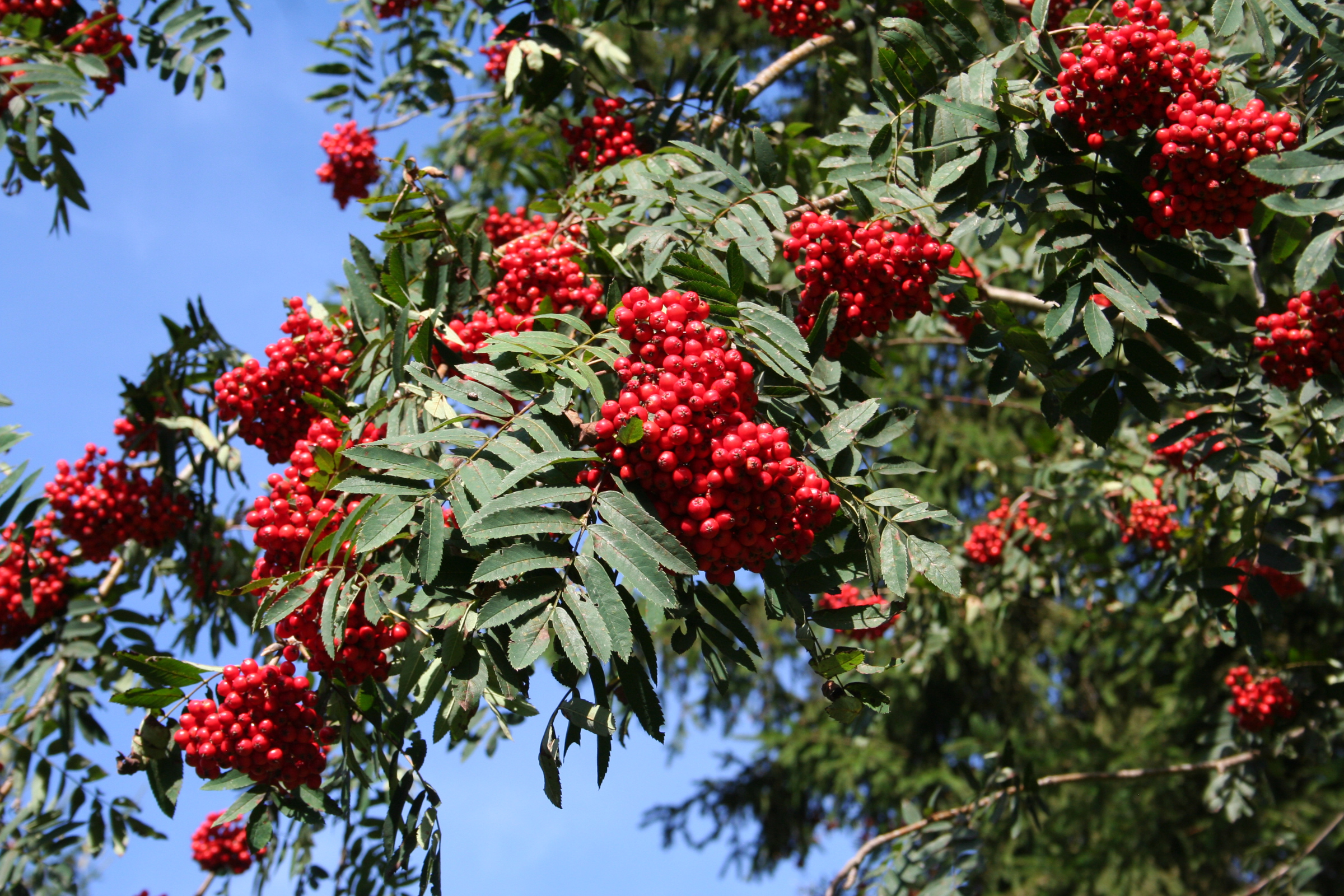
Fig. 1: Caution - easy to confuse, at least when looking at the leaves. The bark of the rowan, on the other hand, is always smooth, sometimes even shiny, while the bark of the service tree is rough and cracked. Once the trees are bearing fruit, it is easy to tell them apart: Left: service tree, right: rowan. Photos: Gregor Aas
Site requirements and competitive behaviour
The service tree prefers warm, sunny locations. It is extremely resistant to heat and drought. It thrives best in calcareous and nutrient-rich soils. It copes well with shallow soils, but also clay soils, provided that these are never waterlogged or deficient in oxygen for long periods. It does not thrive in low-nutrient, acidic soils (pH < 6 throughout the depth of the soil), cool, humid locations, or in the shade of neighbouring trees. As an admixed tree species, the service tree can tolerate the proximity and moderate shading of oaks for several years. However, it does not tolerate the close proximity of common beech.
Uses through the ages: wood, fruit and landscape
In former centuries, the service tree was valued for both its wood and its fruit. It is no coincidence that large service trees are more likely to be found near settlements and in orchards than in closed canopy forests. The extremely strong and tough wood was used for mechanically demanding purposes, e.g. for the wooden cogwheels in grain mills. The fruit is edible raw, but was mainly used to make a cider-like drink and fruit brandies. Due to its high tannin content, however, it was often only processed after exposure to frost. In terms of landscape aesthetics, the service tree is a valuable component of traditional cultivated landscapes, with its spreading crown, striking fruit and attractive autumn colouration.

Fig. 2: Service trees can grow into stately trees - as here in the municipality of Wirmsthal in the Bad Kissingen district. Photo: Klaus-Peter Janitz (AELF Würzburg)
Future importance in times of climate change
Due to its tolerance of heat and drought, the service tree should play a more significant role in forest management in the future. While many native tree species are increasingly reaching the limits of their climatic tolerance, the service tree can partially take their place on alkaline, nutrient-rich sites. As an admixed tree species, it can enrich forest stands ecologically, economically and aesthetically, and help stabilise them against heat and drought.
Forestry measures to promote the service tree
Crowding and competition from the crowns of neighbouring trees are proven silvicultural instruments for promoting the natural self-pruning of individual trees (“plus trees”) of highly competitive tree species in the first 20-30 years of their lives through lateral shading. The fact that this prevents the tree from developing its full vigour potential is accepted in order to produce valuable, knot-free timber. With its low competitive ability, the service tree should however be helped earlier and more intensively if the aim is to optimise its growth and vitality. If valuable timber is to be produced, the branches on the lower metres of the trunk can also be removed with pruning saws, so that knot-free wood can grow in the subsequent decades. If the aim is to preserve the service tree for its rarity or ecological value, however, there is no need for pruning.
Cultivation and thicket stage
The true service tree is available from forest nurseries and, at around €7 for the 30/50 cm category to €12 for root ball plants (50/80 cm), it is around three to four times more expensive than more common tree species (status as of winter 2024/2025). It is light-demanding. Franconian provenances in particular are considered to be at least moderately resilient to late frost. Depressions in the terrain, where the risk of late frost is particularly high, should be avoided. Otherwise, open spaces are just as suitable as planting sites under a sparse canopy of old trees. If the planting material is vital, i.e. stored and transported in very cool and moist conditions, and planted carefully, the service tree is robust and vigorous during the cultivation phase. On sunny and windy planting sites, the leaves can dry quickly again after rain. This protects the service tree from harmful leaf fungi (scab), especially if the area around the tree is well mown in the first few years. Fences or individual protection of the trees are advisable in the case of excessive game populations. Plastic tree tubes offer promising prognoses for at least medium-sized plant assortments, but only in full summer sunlight, as the tubes block out light. Since the planting material is expensive and requires particularly conscientious care in any case, there is no reason not to use wide planting formations. The wider and less regular the planting pattern is, the more important it is to mark the planted trees with stakes sufficiently high to ensure they are not overlooked or accidentally mown down in the tall grass during summer mowing. Service trees must be vigorously promoted at all ages and regardless of quality. Neighbouring trees that shade them from above should be consistently removed. Slight lateral shading is tolerable at the thicket age, although it is not conducive to vitality.

Fig. 3: This young service tree has reached the top of its tree tube. Photo: Klaus-Peter Janitz (AELF Würzburg)
Thinning
Service trees should always be completely free-standing and not have to endure being shaded by neighbouring trees. If the lower 4-6 metres of the trunk are to be knot-free, the lower branches of young service trees can be sawn off. This allows valuable knot-free timber to grow over the following decades. Thinning measures should be carried out when neighbouring trees begin to overshadow the service trees. The encroaching neighbouring trees are removed or girdled during the thinning measure so that they die off.
Regeneration and species conservation
The service tree is known for producing little natural regeneration. The reasons for this are not entirely clear. The following conditions appear to improve the success of regeneration: Full release thinning by removing all competing neighboring trees, so that seed formation is stimulated; thinning of the canopy to allow partial shade on the ground; and fencing, if game numbers are not “forest-friendly”.
Summary
The true service tree seems well equipped to cope with increasing heat and drought. This gives it a competitive advantage over other tree species. On the other hand, it suffers more than other tree species from direct competition for light from neighbouring trees that overshadow it. To preserve the service tree, it is thus a matter of priority to consistently promote all existing specimens, regardless of quality, and to plant new trees in forests and open areas.