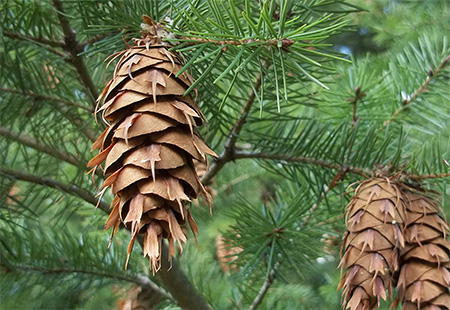


Because Douglas fir has been cultivated in Germany for decades, there is extensive experience in growing this alternative tree species. This experience forms the basis for a general cultivation recommendation that takes climate change into account. Douglas fir has long been an important alternative species on sites that are too dry for spruce. Nevertheless, it should be borne in mind that the provenances recommended for Bavaria up to now come from regions in North America that are characterised by very high winter precipitation. The successful cultivation of Douglas fir in Germany is based on provenance trials that were set up in the 1970s with seed from controlled harvests in the USA. At that time, AWG staff travelled with colleagues from other federal states to the most important harvesting sites, inspected the harvests on the spot, and ensured that the plants grown in Germany were of guaranteed provenance. This approach is necessary again today in order to lay the foundations for provenance and practical cultivation trials for further alternative tree species, and to ensure that nurseries are supplied with verified seed from proven suitable regions of origin.
It is only thanks to trial series like these that we now know the differences between “green” coastal Douglas firs (Viridis) and “grey” inland varieties (Caesia). The cultivation trials provided information on the American seed zones from which the most suitable provenances of green coastal Douglas fir for Bavaria originate. These provenances are characterised by high growth rates and low susceptibility to rust fungi and late frost (Figure 1).
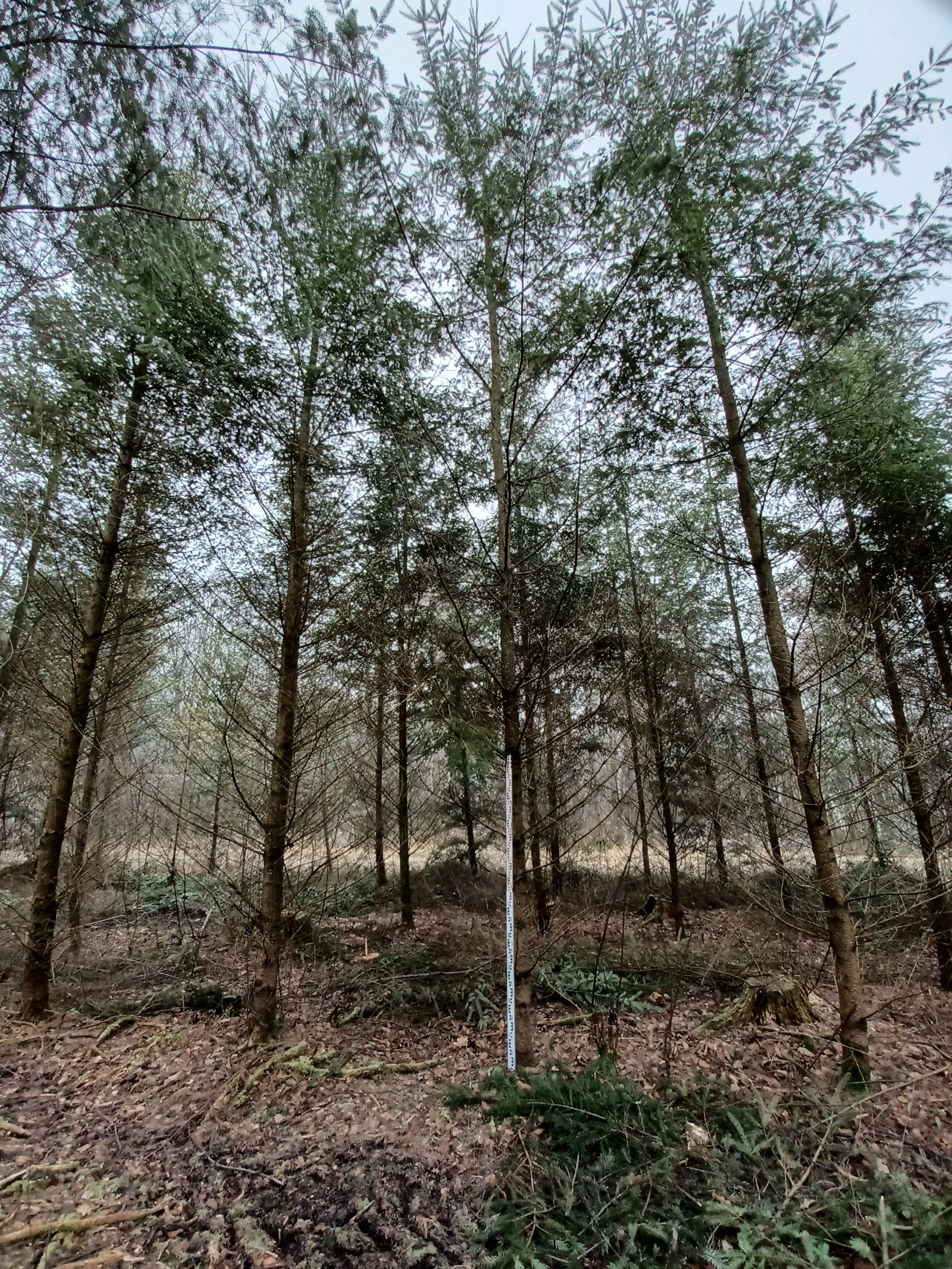
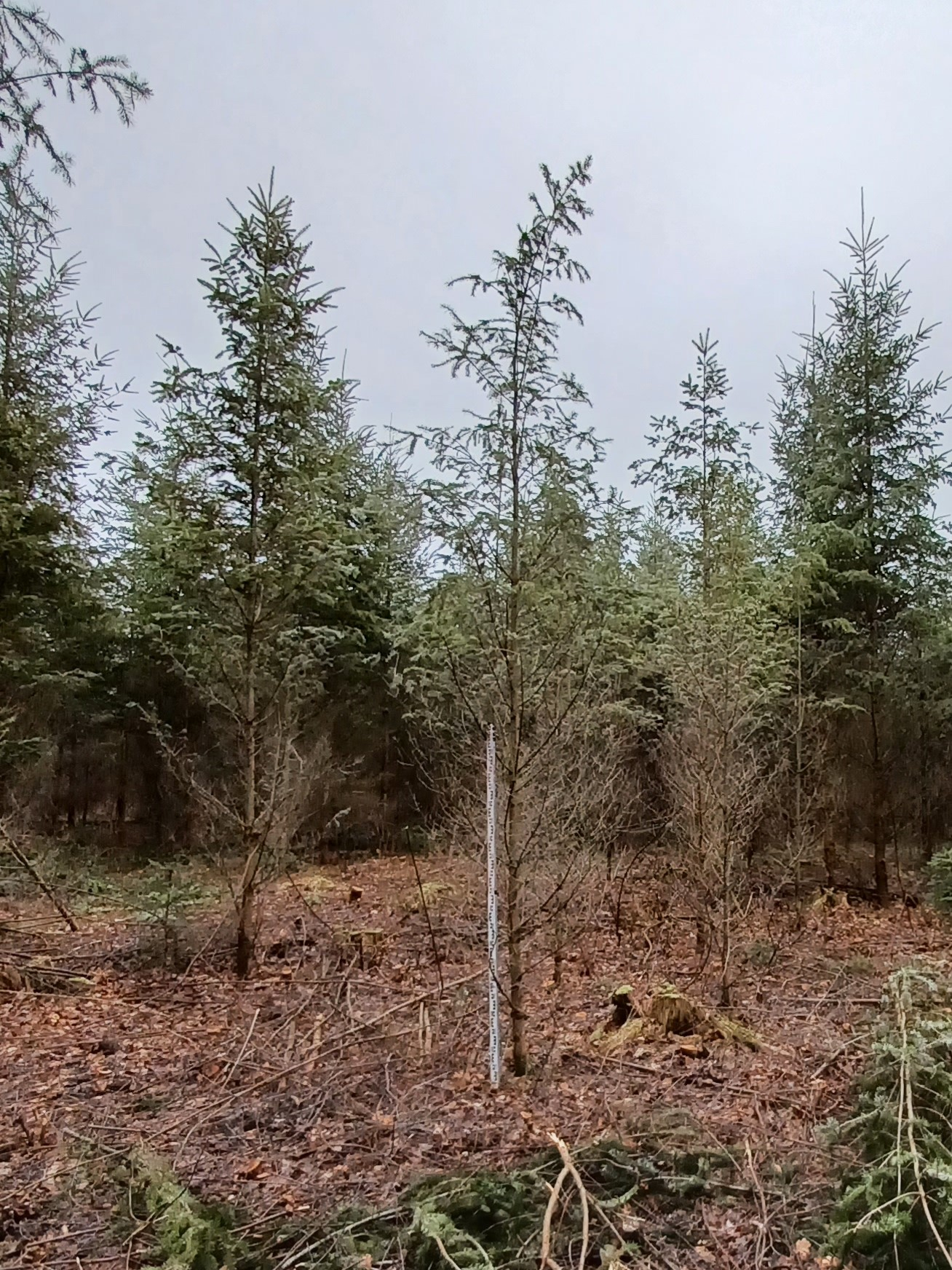
Fig. 1: The very good green provenance “Matlock 1059” (left) and the sluggishly growing grey provenance “Squilax” (right) in the Landshut University Forest. The 2-metre measuring rod is for size comparison. Photo: Karolina Faust (AWG)
The provenance trials of the 1970s were set up at a time when the effects of climate change were not yet noticeable. For this reason, the provenances used at the time were primarily from northern US regions, which corresponded to the southern German climate. The few southern provenances from Southern Oregon and northern California failed in the first few years due to winter frosts.
According to current estimates, Douglas fir seed will continue to be in high demand with increasing warming. The results of the trial in the Landshut University Forest are a good example showing the differences between provenances of a successfully introduced alternative tree species. At the same time, the trial serves as a basis for upgrading high-quality German seed harvesting stands to the “tested” category in accordance with the Forest Reproductive Material Act (FoVG).
From the nursery to the trial area
In spring 2006, provenances from numerous German Douglas fir stands, from three domestic seed orchards, and from seven American seed harvesting stands were sown (Figure 2). The assignment of the provenances to the varieties was verified using biochemical genetic laboratory methods.
The first differences between provenances became apparent at the nursery stage: The grey provenances had fewer losses, as they were less susceptible to winter frost. The green coastal provenances showed significantly better height growth - also due to the formation of Lammas shoots. After planting in autumn 2008, losses of 33 % were recorded among the near-coastal provenances due to the subsequent spring drought. By contrast, losses among the grey, more drought-tolerant provenances were just 3 %.
In May 2011, the opposite effect occurred as a result of severe late frost: The early-sprouting, grey inland provenances now showed damage rates of 35 %, while the late-sprouting green origins were not affected by frost.

Fig. 2: Harvesting regions of the used Douglas fir provenances in North America and Germany.
Development in the establishment and thicket stage
By age 14, 23.6 % of the trial specimens died on average across all provenances (Figure 3). Significant differences were observed between green and grey provenances: at an average of 39.3 %, the losses among the grey provenances were more than twice as high as those among the green provenances. In the case of the grey American provenance “Squilax”, the losses also increased sharply during the polewood stage. The average failure rate for the green provenances was 17.9 %. The “Hürtgenwald”, “Schmallenberg” and “Darrington” provenances recorded losses of less than 10 %.

Fig. 3: Failure rate percentages of provenances in different years up to age 14
After 14 years, the trial plants reached an average diameter of 9.6 cm and a height of 9.1 metres. Figure 4 shows the significant differences in growth performance between the green, vigorously growing provenances, and the grey, sluggish-growth provenances. The green provenances “Kaiserslautern” and “Döhlen”, as well as seedlings from the American seed sources “Darrington”, “Humptulips” and “Matlock” showed above-average growth in height and diameter. These results are in line with observations made in earlier provenance trials conducted by the AWG. The measurement results of this study confirm previous cultivation recommendations. The lowest growth rates were shown by the grey varieties “Squilax” and “Salmon Arm”, as well as “Tharandt”, “Mittweida” and “Templin”. It is striking that the green two-clone plantation from Brandenburg was overtaken by other provenances in terms of height and thickness growth with increasing age.
The green American provenances are in almost all cases the best provenances in terms of their performance. The growth of the green provenances from Germany varies widely, on the other hand - an indication that they may not be pure-bred harvest seed stands. This may however also be due to the existence of marked differences in subpopulations on small areas within the areas of occurrence of the coastal Douglas fir.

Fig. 4: Growth performance of the provenances as a function of BHD and height at age 14 (green provenances marked green, grey provenances marked grey, with the lighter colours representing German provenances and the darker colours representing American provenances)
Quality
Trees of above-average diameter development tended to have larger branches. Trees with large branches have a larger assimilation area and are more competitive. This correlation was more pronounced for grey provenances than for green provenances. Green provenances were more vigorous and therefore had a considerably lower proportion of stems with fine branches than the grey trial specimens. In forestry practice, pruning is therefore essential for the production of high-grade timber when the green, vigorous provenances are being used. The seed taken from the green two-clone plantation resulted in an exceptionally high proportion of individual trees with fine branches. The clone selection was obviously mainly orientated towards quality, while accepting lower growth.
At 9.8 %, a surprisingly high proportion of forked trunks for Douglas fir was observed on the trial area. The green provenances tended to develop forks somewhat less frequently than the grey provenances. As there was no occurrence of snow breakage or other factors that cause forking, genetic causes for the formation of forks cannot be ruled out. The “Matlock” provenance, a provenance of above-average growth, had an extremely low proportion of forking, at 1.8 %.
There were no significant differences in trunk shape between green and grey provenances. On average, 57.1 % of the trunks in the trial area had predominantly very straight shafts.
The summarised evaluation of the quality characteristics “forked shafts” and “knots” revealed above-average shape characteristics, especially for the green coastal provenance “Nanaimo Lake”.
State of health
The criterion of vitality is gaining in importance in times of climate change. Infection with Rhabdocline needle cast and Swiss needle cast led to significantly different levels of needle cast in green and grey varieties. The green provenance “Matlock” showed no signs of damage, still displaying needles at least three years old. In contrast to this, needle loss was well advanced in the grey progeny, which only maintained one year old needles.
On average, 3 % of all trees were damaged by bark scale disease (Phomopsis). The fungus Phacidium coniferarum penetrates the trunk on dead branches and causes bark necroses, which are characterised by shield-shaped bark detachments. Green and grey provenances were affected to the same extent.
Conclusions

Fig. 5: Old-growth Douglas firs near Lake Cushman, Washington. Photo: AWG
The development of the trial confirms previous experiences of the above-average growth performance of green Douglas fir varieties - despite an increase in the mean annual temperature in the Landshut area of 0.44 °C and an increase in the number of annual summer days from 44 to 68 days during the trial period.
The US provenance “Matlock”, from the state of Washington on the west coast of the United States, proved particularly convincing in terms of growth, vitality and quality. The Rhineland-Palatinate provenances “Gerolstein”, “Daun” and the Bavarian seed harvesting stand “Lerchenfeld” also scored well in all criteria. These stands are also recommended for seed harvesting in the future. The grey Douglas fir varieties on the other hand did not satisfy expectations, due to sluggish growth and high losses caused by late frost.
Drought and late frost are critical for many alternative tree species during the establishment phase. This observation is particularly true for the long-established Douglas fir. Switching to more drought-tolerant inland provenances would come at the cost of a higher susceptibility to late frost. These provenances are therefore not an option in a changing climate.
Further provenance trials are needed to test provenances from more southerly, drier and warmer areas of the USA with regard to their suitability in a changing climate. Schüler and Chakraborty (2021) recommend that inland provenances should continue to be avoided for cultivation in Central Europe. These will lose potential cultivation area as a result of the warming caused by climate change. The authors refer to southern European studies that have shown that Californian provenances have better resistance to drought stress than provenances from further north, and may thus be suitable for future central European conditions.
The trial underlines the importance of selecting suitable provenances. In the University Forest, it is an important object for training purposes.
Summary
Despite numerous dry years during the trial period, the green coastal provenances of Douglas fir in the Landshut University Forest performed significantly better in terms of growth than the grey inland provenances, which are more susceptible to late frosts and rust fungi. With the decreasing frequency and intensity of late frosts under climate change, new provenance trials are needed to test the more drought-tolerant coastal provenances from California and Southern Oregon.