



One part of the MultiRiskSuit project, which is being carried out by the Bavarian State Institute of Forestry, is analysing the potential future risk of forest fires in Bavaria. The scientific findings are to serve as a basis for preventive measures against the growing risk of forest fires in Bavaria. After all, forest fires not only have economic and safety implications - they also have potentially significant ecological and even social impacts. The calculations of the future meteorologically-related forest fire risk provide an important data basis for the identification of areas within Bavaria at particular risk of forest fires. These in turn can be used to prioritise areas in which to focus on preventive measures such as fire breaks and forest fire protection barriers, the provision of sufficient water capacities for extinguishing fires in the forest, and the preparation of deployment maps for use in forest fire situations.
Among other things, the project uses the Canadian Forest Fire Weather Index (CFFWI) and the “Bayern-Ensemble” (LfU 2020), a compilation of climate models that have proven particularly relevant for the Free State of Bavaria. The combination of climate models and CFFWI allows an assessment of the long-term development of the weather-dependent forest fire risk situation in Bavaria to be made. Some of the results are presented below.
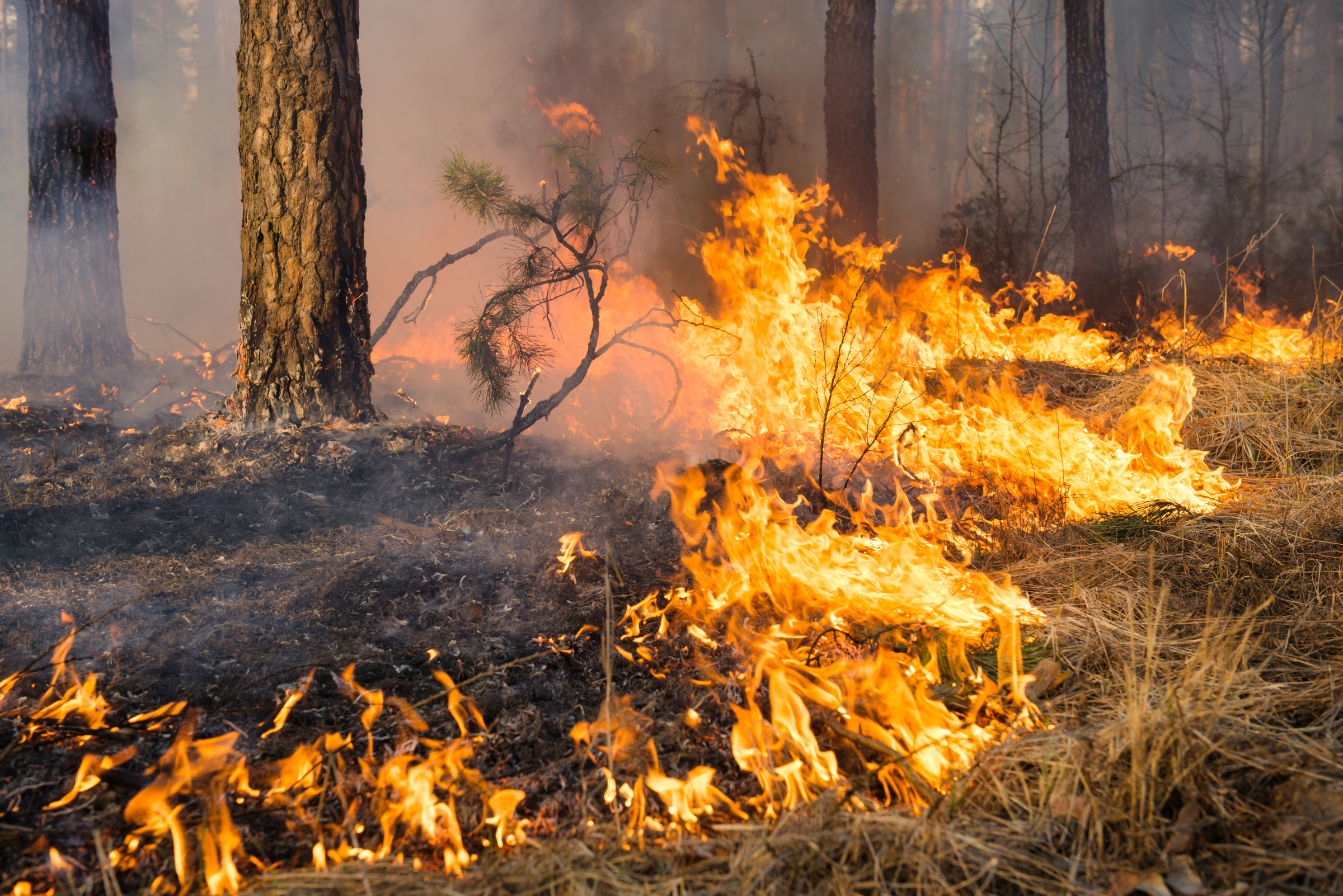
Fig. 1: If the conditions are right, one spark is often enough; here a ground fire in a pine forest. Photo: Gilitukha, PantherMedia
Fire weather is becoming more frequent
The analysis shows that the meteorological potential for prolonged warm and dry periods is increasing significantly. Figure 2 shows the development of the average number of days with a high risk of forest fire (CFFWI ≥ 4) over a thirty-year moving average. The CFFWI is a reliable method for estimating the meteorological forest fire risk, as it reacts extremely sensitively to the simultaneous effects of drought, heat and wind.
Steering is possible

Fig. 2: Particularly in more severe climate change scenarios (RCP 8.5), there is a considerable rise in the number of days with a high risk of forest fires on average in Bavaria (> 200 %).
It is also clear that future developments are by no means predetermined. Looking at the latest climate change scenarios, based on so-called “representative concentration pathways” (RCP), which depict the increase in CO2 concentration in the atmosphere, the number of days with an increased risk of forest fires increases in all of the scenarios analysed. However, the extent of this increase varies considerably. Even the most moderate scenario (RCP 2.6) leads to an increase of around 50 % compared to the end of the last millennium. The medium scenario (RCP 4.5) shows increases of up to 100 %. The most extreme climate change scenario (RCP 8.5) could even lead to an increase of more than 200 % in the number of days with an increased risk of forest fires in Bavaria. This shows the urgent need to improve fire protection and thus forest protection in our forests.
The north-south divide
The development of the forest fire risk over time shows regional differences (Figure 3). The meteorological potential analysis shows that the particularly warm and dry areas in the north-western part of Bavaria are most at risk. However, the rise in the number of fire risk days in southern Bavaria should not be underestimated, either. Especially under the severe climate change scenario RCP 8.5, a significant increase in the risk situation is forecast here by the end of the century.
The effect of various negative influencing factors occurring at the same time is particularly problematic. The increased potential meteorological forest fire risk as presented here affects forests that are already marked by drought and the associated damage. This combination exacerbates the already existing challenges considerably and shows the magnitude and importance of the tasks the forestry industry is likely to face by the end of the century.

Fig. 3: The increase in the risk of forest fires varies depending on the climate change scenario, but the spatial trend is clear: The warm, dry north-west will be most affected.
Sensitivity to changes in the input variables

Fig. 4: A sensitivity study at selected Bavarian forest climate stations shows the complex dependence of forest fire risk on meteorological input variables.
As part of a sensitivity analysis, dependencies of the CFFWI on its input variables were analysed in more detail (Figure 4). To do so, model data with daily resolution was analysed over a 150-year period from 1951 to 2100. The plotted curves show the sensitivity of the physical model to the input variables under real conditions. The y-axis represents the mean CFFWI values, which correspond to the relevant percentiles of the corresponding input variable given on the x-axis. The lowest (highest) percentile represents the minimum (maximum) values of the input variables, which, in the case of temperature, for example, is in turn associated with a low (high) CFFWI value.
High CFFWI values are typically reached with low humidity, low precipitation and high temperatures. Despite the assumption that high wind speeds increase the risk of forest fires, the analysis shows that this is not always the case under real conditions. Strong winds alone do not directly lead to an increased risk of forest fires; the risk only increases when they occur in combination with other extremes. The limiting effect of precipitation is also clear, as even small amounts of precipitation cause the CFFWI value to fall towards zero. The study shows which input variables are particularly relevant for the risk of forest fires under real conditions, and not just of great influence in the model. In addition, the results show that the model works consistently in the context of Bavarian environmental conditions, since comparable curve shapes are observed at all locations without any noticeable incontinuities.
The four sites were chosen to follow the gradient of Bavarian environmental conditions from north-west to south-east. As expected, the model reacts with lower CFFWI values at the cooler, humid locations (Würzburg > Dinkelsbühl > Freising > Berchtesgaden).
Summary
Overall, future meteorological developments indicate that the risk of forest fires in Bavaria is likely to increase significantly. The Complex Forest Fire Weather Index (CFFWI) reflects the complex interplay of several meteorological factors that promote the risk of forest fires. It is particularly clear that a high risk of forest fires is to be expected when several of these factors occur simultaneously - especially at extreme levels. Temperature and humidity are the key factors influencing the level of the CFFWI, while precipitation plays a limiting role. These findings underline the importance of a comprehensive understanding of meteorological conditions for the prediction and management of forest fires in Bavaria.
The project is funded by the Federal Ministry of Food and Agriculture (BMEL) and the Federal Ministry for the Environment, Nature Conservation, Nuclear Safety and Consumer Protection (BMUV) through the Agency for Renewable Resources (FNR) as part of the Forest Climate Fund funding guideline (funding reference: 2220WK41F4) and in co-operation with various German state institutes.
